Showing posts with label Peter Cushing. Show all posts

Saturday, December 20, 2025

Friday, October 24, 2025

Trailer - THE CURSE OF FRANKENSTEIN (1957)


Revisited this one last night and found myself loving it even more than my memory told me I would. In the past I've found the slow build to the birth of the monster difficult to deal with when rewatching this classic. But this time it felt perfectly paced and structured to bring almost any willing audience along for the horrific sights it has to show them. Decades after it changed the genre it still stands as an impressive accomplishment! Vibrant and alive it kicks in the door and demands to be seen - again. 

Sunday, November 13, 2022

Magazines and Monsters #53 - THE BEAST MUST DIE (1974)


On the latest episode of Magazines and Monsters Nic Brown and I are guests to discuss a 1970’s werewolf movie! THE BEAST MUST DIE (1974) is a rare non-anthology horror film from Amicus productions and that is one of many reasons it stands out. Another is that this is a werewolf film in which the creature eschews the standard cinema two-legged Wolf Man variant for a four-legged wolfy monster. This choice is usually given by viewers as they turn up their noses at the film but fans of the movie think it has caused this mystery/horror hybrid to age very well. Others dismiss the film for it’s famous Werewolf Break in which the audience is given a minute of paused screentime to make a guess about the identity of the secretive lycanthrope. I’ve often wondered how many people actually solve the mystery before the final reveal.

The three of us discuss the movie from top to bottom defending much of it and suggesting fixes for certain strange moments. We had a great time with this film and hope you’ll enjoy listening. 

Sunday, January 09, 2022

Brief Thoughts - THE ABOMINABLE SNOWMAN (1957)

I revisited THE ABOMINABLE SNOWMAN (1957) last night for the first time in years. My memories of the film were that it was a solid effort but that it was slow and dry at times. This viewing proved I was wrong on both counts.

I’ve not done a full survey but this might be the best Yeti film of all time. The script is literate, involving and clever in its narrative. Nigel Kneale was always a brilliant writer of speculative fiction and my feelings that this story was one of his weakest were ridiculous. This story shows all the hallmarks of his better-known works such as the Quatermass tales and his 1989 adapted screenplay for The Woman in Black. He creates well defined characters quickly and with the kind of details that build over the course of the film. This approach is complimented by the usual intelligent direction by the great Val Guest.

Guest is one of the under sung heroes of British fantastic cinema. Responsible for a long list of classics including the first two Hammer Quatermass films, THE DAY THE EARTH CAUGHT FIRE (1961) and WHEN DINOSAURS RULED THE EARTH (1970) he was always good at getting the right moments onscreen in an exciting way. His crime and war films show his immense skill as well and I highly recommend his lesser-known pandemic drama 80,000 SUSPECTS (1963) to see how talented he was as a writer too. With these two men leading this production it should be no surprise that the quality is very high and the resulting picture is excellent. Maybe the last time I watched THE ABOMINABLE SNOWMAN I was distracted or in a foul mood. Regardless, it is a fine movie and worth many future viewings.


Saturday, June 05, 2021

Trailers From Hell - HORROR EXPRESS (1972)


Joe Dante makes a good case for this excellent film that has to stand as one of the best pairings of Cushing and Lee onscreen. Such a great film and one that should be a part of every horror fan's collection. 


Monday, July 06, 2020

The Bloody Pit #108 - TWINS OF EVIL (1971)


Mark Maddox returns to discuss another Hammer film!

Things became very different for vampire films in the 1970’s. Topics that used to be ignored or, at most, alluded to were suddenly able to be placed front and center in the narrative. No longer did a blood sucker’s victim have to merely cower in fear. Now they could react with lust or the real desire for the monster to put the bite on their necks to show the attraction these creatures might generate as part of their appeal. The sexual side of vampires could become a central part of the story allowing the carnal needs of both monster and victim to be explored. TWINS OF EVIL (1971) takes a pair of identical looking young girls on the cusp of becoming women and shows us two different reactions to a vampire’s sex appeal. The film clearly has a point of view but it is possible to read some darker ideas in the story as well.

We start by discussing the loose Karnstien trilogy that TWINS OF EVIL (1971) concludes. Then we move into a broad talk about the tone of Hammer films’ output during the 1970’s and how the studio became more of a place for independent productions guided by the old guard than a production house. This approach created a less controlled but very interesting run of movies that allowed for experimentation in both style and story as the public’s attention wandered away from the classic gothic horror model Hammer had epitomized since 1957. So even if new settings were not to too quickly embraced, fresh elements could be folded into the tales. This meant more adult themes, more  violence and as much nudity as they could get away with! We talk about how this film also manages to put religious hypocrisy front and center and embodies it in one of Hammer’s most iconic actors, Peter Cushing. I argue in the show that this is one of Cushing’s best performances for the studio because the script gives him an arc to play unlike his usual villain or hero roles.


If you have any comments about the show please write us at thebloodypit@gmail.com to let us know what is on your mind. Is this your favorite of the Karnstien films? Thank you for listening and we’ll be back soon.

Apple Podcast LINK

Direct Download LINK


Wednesday, November 20, 2019

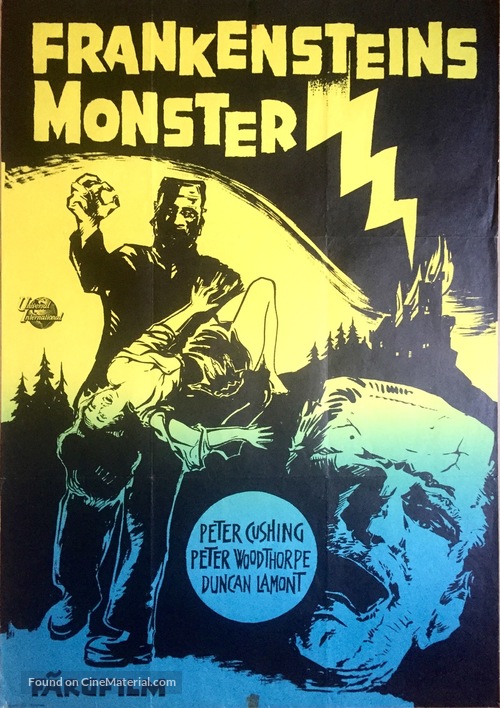
THE EVIL OF FRANKENSTEIN (1964) Poster Art


Often derided but actually great! 

Saturday, March 30, 2019

Re-viewing THE SATANIC RITES OF DRACULA (1973)


Because THE SATANIC RITES OF DRACULA (1973) was recently bought out on Blu-ray by Warner Archives I decided to revisit it. As the last of Hammer's Dracula films I've always considered this to be the nadir of that studio's run of vampire epics. My memories of it were that it was poor on almost every level with barely any actual Dracula presence in the story. It was only because of the chance to see a cleaned up HD print showing the film at it's best that I decided to rewatch it and I am glad I did!

I remembered only a few things about the film including the one image almost everyone takes from it. This would be the vampire brides rising from their basement coffins to attack potential victims. These sequences are still quite memorable and effective but the things I had forgotten were numerous!

Bizarrely, I had forgotten that Peter Cushing was even in this film! How the hell did I edit Cushing out of this? Was I trying to excuse him from a movie I thought was beneath him? But there he is front and center playing the same Van Helsing character he played in the previous year's DRACULA A.D. 72 and getting involved in the mystery at the heart of this one. And he's great, as always. I had forgotten that the amazing Freddie Jones is in this doing his usual brilliant, brittle loon character who is teetering on the edge of madness. And he's great, as always. I had completely forgotten the entire MI-6 James Bondian style plot of the film and I found myself very much enjoying how well written it is. I was having quite a lot of fun before the supernatural element in the story advanced beyond somebody possibly screwing over old rich people with occult silliness. Watching British spies work off-book to discover if their superiors are doing dastardly things is entertaining enough on it's own.

But the thing I was most surprised that I had completely mis-remembered was the ending of the film. I correctly remembered that Dracula gets caught in hawthorn bushes but incorrectly thought he was killed by this entanglement. No, no! Drac gets stopped by these thorn bushes and then Cushing grabs a convenient piece of wood and stakes that sucker good! And I mean he leans into this action. It is vicious and well done. How could I have forgotten this? It's the end of the movie! And the end for Hammer of the Lee Dracula character. It's a great vampire destruction and I just edited it out or my head. Nuts!

I stand corrected on the qualities of THE SATANIC RITE OF DRACULA (1973). It was not a sad, silly, sloppy ending for the series. It actually quite strong and I'm glad that the Blu-Ray exists.


Wednesday, October 03, 2018

Re-viewing THE GORGON (1964)


Revisted THE GORGON (1964) because it's now available on Blu-Ray and it has been years since I last watched it. I've always liked this Hammer fantasy/horror story but this time I was surprised by the power of my reaction. I actually loved the film this time and found myself drinking it in and, once it was over, thinking about immediately watching it again. Director Terrance Fisher is often quoted as saying that, for him, the Hammer horror films he made were fairy tales and surely THE GORGON is a perfect example of this idea. Stepping outside the usual horror tale types for a story rooted in myth but still set in the vaguely mid-European local that all Hammer films seem to inhabit, the script is extremely tight. John Gilling is a known quantity for crafting some of the studio's odder 1960's efforts including THE REPTILE and THE PLAGUE OF THE ZOMBIES but I hadn't realized he wrote this film. Indeed, his list of script credits reveals a set of films that add to my appreciation of his career.


The standard complaint leveled against THE GORGON has always been that the central mystery of 'who is actually the mythic creature come to life' is obvious. It had been so many years since my last viewing of the film that I had allowed that criticism to seep into my opinion, so I was surprised this time through. The script very definitely sets up a more probable person to be the human form of the hideous Mogera. I had forgotten this! Of course, the presence of the lovely and talented Barbara Shelley generally indicates that her character will play a larger than average role, but the film does present a good argument for the frequently escaped old lady lunatic than my memory or the film's reputation had indicated.


Also, I found myself much happier this time around with the admittedly weaker than I would like snake-head effect. No, it's nowhere near Harryhausen levels of effects brilliance but it is much better than my general recall suggested. In fact, the whole film looks so beautiful in high definition that I feel almost like it's the first time I've ever really seen the movie. I think my last viewing was from a TV broadcast with washed out colors and fuzzy details. This time, seeing was loving! This is Hammer still at the top of it's game and trying to stretch outside their usual set of monsters. I think they succeed very well!

Plus - Christopher Lee is the hero! In a huge mustache! And bonus Patrick Troughton! 


Monday, January 22, 2018

The Bloody Pit #63 - DALEKS' INVASION EARTH 2150 A.D. (1966)


DALEKS' INVASION EARTH 2150 A.D. is the second and, sadly, last of the feature films made with Doctor Who as the central character. Or, at least, the ostensible central character. As you might have noticed, The Doctor isn't even mentioned in the title of this science fiction tale. In fact, that is one of the odder things about this movie - there is very little Doctor Who! Why? Well, there are several reasons but with the great Peter Cushing in the role it's a crying shame that his screen time is so limited. Not so with the titular Daleks as they glide around enslaving humanity and digging deadly mine shafts with a plan to do something to the planet's core that I'm still trying to completely understand. Regardless, they are ruthless murdering metal monsters and they must be stopped even if their spaceship is the coolest thing ever! 


Stephen D. Sullivan joins me again to take a look at this classic little British export. We examine how closely it hews to the original television version of the story as well as compare how it stands next to the first of these cinematic Who tales. There is some disagreement about which of the two films is better so we dig into the differing tastes that elevate one over the other. We talk about the illnesses and accidents that marred the production, the strange product placement visible in the dystopian future and the sequences we feel the movie would be better without. We even get to talk a little about the fine character actors that started their Doctor Who association with this film. I've done my best to excise the worst digressions but, for the curious, there is a lengthy off-topic conversation appended to the end of the show in which we discuss Batman. We are geeky, after all! 

The show can be reached at thebloodypit@gmail.com for any comments or criticisms. Thank you for downloading and listening. 


Stephen Sullivan's Site 

iTunes LINK

MP3 Download LINK


Friday, January 19, 2018

Poster & Ad Art for DALEKS INVASION EARTH 2150 A.D. (1966)


Advertising artwork for the second Doctor Who feature film starring Peter Cushing. 


Thursday, May 04, 2017

Trailers From Hell - THE SKULL (1965)


It's time to rewatch this one, especially now that it's available on Blu-Ray! 

Saturday, March 25, 2017

Monday, November 21, 2016

FRANKENSTEIN AND THE MONSTER FROM HELL (1974)

Hiding behind one of the worst titles to ever grace a Hammer horror movie is one of the best of the company's long running series following the grisly adventures of Baron Victor Frankenstein. 


Frankenstein and the Monster from Hell was Hammer's seventh, but only Terence Fisher's fifth, in the series and it is a fitting high note to both Hammer as a studio and Fisher as their signature director. Fisher was always a solid director with a great eye for setting shots and an ability to get the most out of sometimes underwritten scripts. With this film he showed his considerable strengths one last time in a dark, grisly tale that could have pointed toward a revitalization of the gothic horror genre. By casting a young, handsome man to accept the mantle of Dr. Frankenstein and allowing the always wonderful Peter Cushing to return to his greatest horror role, it should have worked perfectly. Alas this was not to be. Hammer was suffering from financial problems and by 1976 was closed as a viable production house. There would be no more Frankensteins from the studio that reinvented the horror film — in living color — less than 20 years before.


Dr. Simon Helder (Shane Briant) is an eager young man following in the footsteps of the legendary Baron Frankenstein. In a small apartment he is using Frankenstein's published works (?) as a guide for his experiments and is slowly constructing a creature out of parts taken from various cadavers. His procurer is a local grave robbing drunk (Patrick Troughton) who — when he's finally nabbed by the constables — is more than happy to inform on his employer in hopes of a shorter jail term. Simon is promptly arrested for "sorcery" and sentenced to 5 years in the nearby asylum for the criminally insane. It's exactly this institution where the notorious monster maker himself was incarcerated years before. Upon his arrival Simon appeals to the warden for information about Dr. Frankenstein. Momentarily unaware that Dr. Helder is an inmate rather than a visiting physician, the warden explains that the man died some years before and is buried on the grounds. Placed in the hands of the asylum's keepers Simon is brutally welcomed with a high pressure water hose until the resident doctor appears and disperses the watching patients. The medical man attends to Simon's wounds and explains that he is (as suspected) Victor Frankenstein, now going by the name of Dr. Carl Victor. He has the warden under his thumb for various unsavory reasons and runs the asylum with a free hand. The older man is in need of an assistant and makes the young fellow an offer of the relative freedom of the institution if he will help with the general care of the inmates. Simon agrees and soon enough has also joined his mentor in a new attempt to create a more perfect creature (played by David Prowse) from pieces of dead bodies.


Following the template set out by the earlier films in the series, Frankenstein and the Monster from Hell gives us a villainous mad scientist and a sympathetic monster but also throws in the younger protégé as a wild card. Carefully the script shows us Frankenstein's cold-hearted nature barely covered by a veneer of humanity. Even his kind attentions to his mute female assistant Sarah (Madeline Smith) are shown to be matter of necessity. He has cultivated her as a nurse because of his inability to perform delicate surgery with his injured hands. 


Several times the film makes the point that Frankenstein is a rather uncultured man unable to appreciate music, mathematics, or even love itself. If fact, it's these finer aspects of humanity that the good doctor tramples completely in his blind quest to play God. He can only see these finer capabilities as indicators of good components for his work. He covets an inmate's brilliant, talented mind and pushes him into suicide to gain it for his experiments. He is focused so completely on his goal that he's become not just misguided or evil, but inhuman. He consistently destroys anything in his grasp to further his experiments but has no understanding or concern for what he leaves in his bloody wake. Frankenstein's life work has destroyed untold numbers of lives and by the end of this movie it's quite apparent that he will never comprehend the cruelty of his actions. He is irredeemable.


The only bright spot for the future is seen in Helder's revulsion at his mentor's eventual decision to mate Sarah with his failed monster. At this point her nickname of Angel evokes the idea of saintly purity soiled by human malice and could be called the perfect metaphor for this movie series — the beauty of the creation of a new life corrupted by horror of science used without compassion. It's only in Helder's break with Frankenstein over Sarah that we see the possible end to the years of horror carried out by the older man. If there had been another film in the series with Helder as the main character it would have been interesting to see if this element of humanity was kept. But I suspect such niceties would have been tossed out for more of the same. Still, this film did a good job of injecting some new ideas into the old Hammer formula.